The Psychology of Wedding Planning
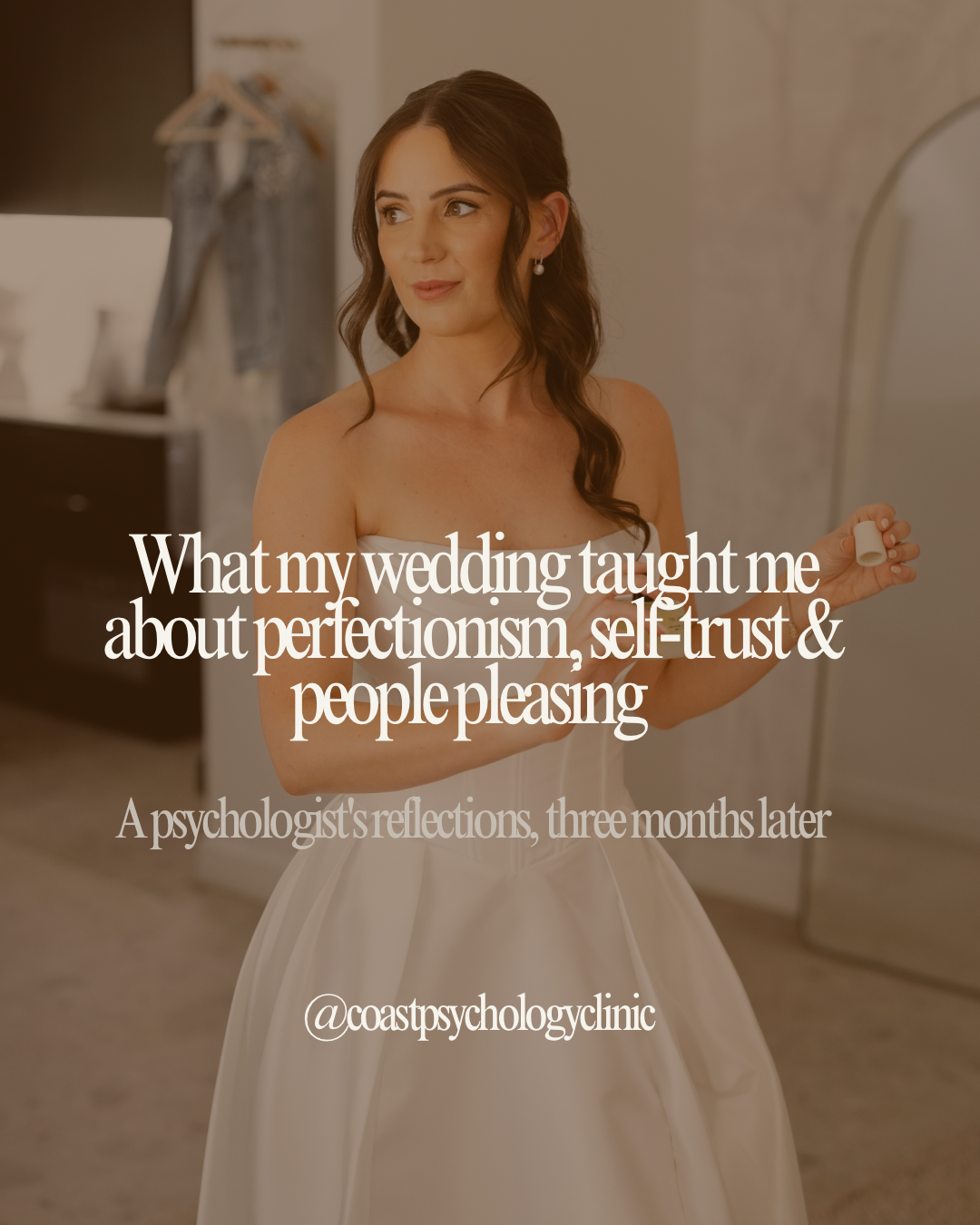
Three months ago, I got married.
And as a psychologist, I have some thoughts.
It's taken me until now to understand why weddings can be such psychologically challenging experiences.
Weddings have a way of bringing every perfectionistic, self-sacrificing and people-pleasing tendency you have straight to the surface. I hear you, of course it does. Before I started planning my wedding, I was hyper-aware that this would be a challenging experience.
I just didn't realise how many different parts of me it would challenge.
Here are my three biggest learnings, less about weddings, and more about the psychology
1. Weddings reveal where self-sacrifice is hiding
Most women (and I recognise this can absolutely apply to men and non-binary people planning weddings too) don't consciously decide to put themselves last.
It's usually far more subtle. You compromise before anyone asks.
You prioritise other people's preferences before you've even considered your own.
You become so focused on managing everyone else's experience that you lose sight of your own.
Looking back, there are dozens of tiny examples of this in my own wedding planning process.
I wish I'd spent more time considering what I genuinely wanted before consuming hundreds of other people's weddings online.
I wish I'd been clearer about how involved I wanted different people to be.
I wish I'd trusted my preferences more, even when professionals suggested alternatives.
The wedding didn't create these tendencies.
It simply revealed them.
And that's what meaningful life events often do.
2. Weddings force you to practise tolerating uncertainty
I spent a lot of time trying to reduce uncertainty.
Researching.
Planning.
Organising.
Preparing.
I realise that no amount of preparation can remove the vulnerability of caring deeply about something.
When something matters, your mind will often search for certainty. This can show up in different ways:
You might have bad dreams.
You might imagine things going wrong.
You might second guess decisions.
You might replay moments afterwards.
This is simply what happens when something is deeply important to you.
The lesson isn't how to eliminate the uncertainty. It's how to tolerate it.
3. Weddings are a surprising lesson in boundaries and self-trust
My biggest reflection three months post-wedding?
A wedding is often the first time many women are publicly asked to hold their own needs, preferences and boundaries in the middle of competing expectations from family, friends, traditions, social media and an entire wedding industry.
Everyone seems to have an opinion.
Everyone has advice.
Everyone has expectations.
And somewhere amongst all of that noise, you're asked to decide:
What matters to me?
What feels right for me?
What am I willing to disappoint people over?
I realise now, that this may be why so many people call it a rite of passage.
Not because of the wedding itself.
But because of what it teaches you about yourself and others in your life.
If you're planning a wedding right now, or coming down from one, let this be your permission slip to stop judging yourself for not doing it perfectly.
Pay attention instead to what the experience is teaching you.
About your boundaries.
About your people-pleasing.
About your perfectionism.
About your capacity to tolerate uncertainty.
Release the pressure of getting it all right.
You're not just planning a wedding. You're navigating one of life's biggest transitions while being observed, advised, influenced and evaluated from every direction.
The goal isn't perfection.
The goal is not to lose yourself in the process.
Planning a wedding and feel you’re losing yourself in the process? Or still processing the experience months later?
We'd love to help. Reach out at info@coastpsychologyclinic.com